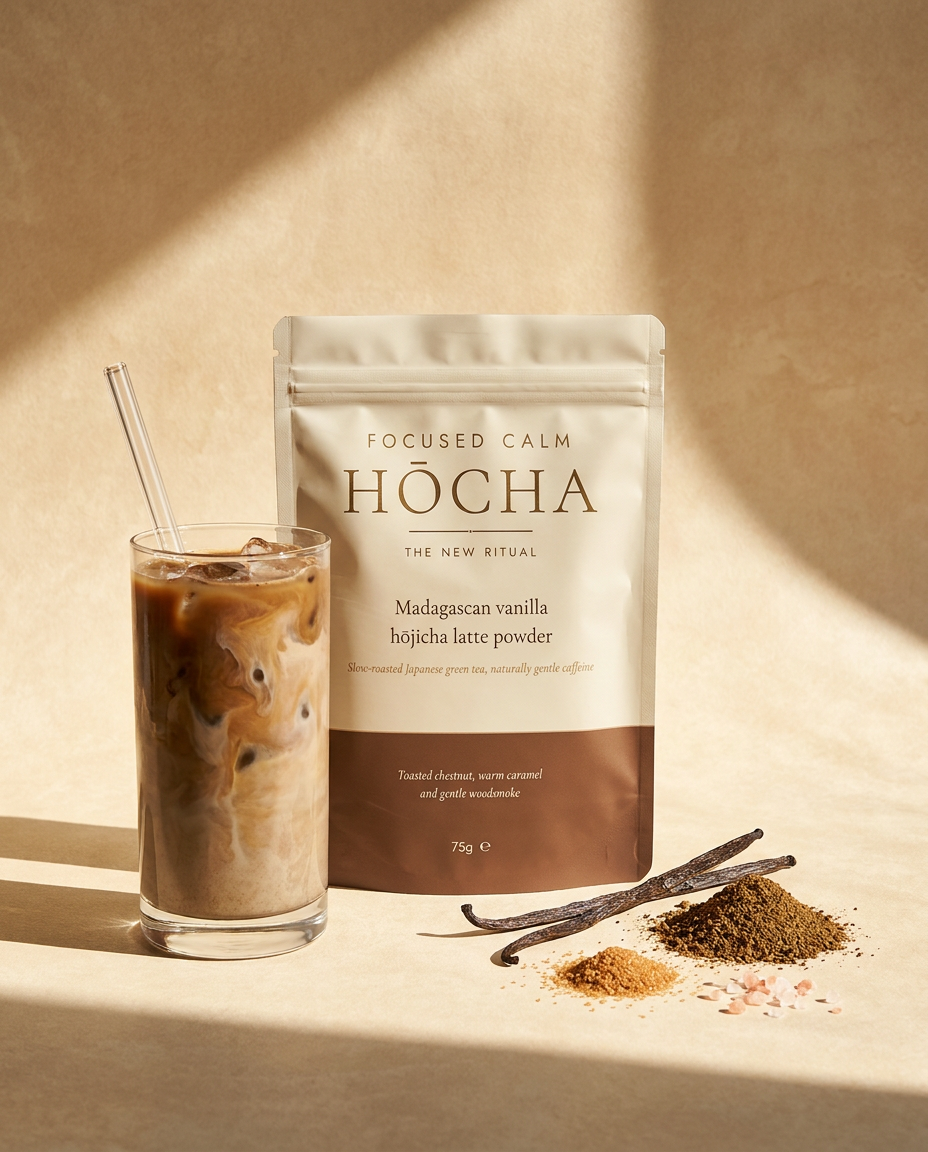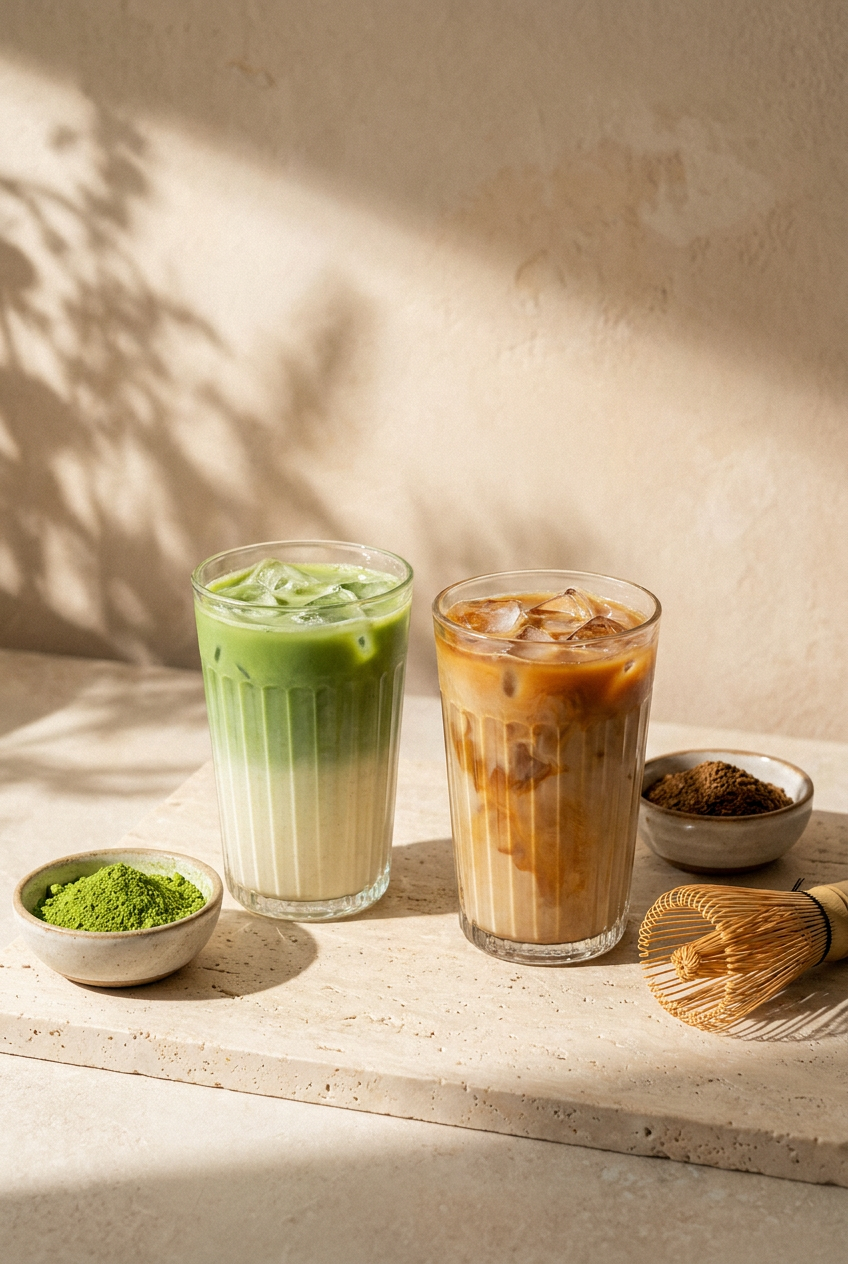
Both come from the same plant. Both arrive as a fine green-adjacent powder. Both get whisked into lattes by people trying to drink less coffee. And yet hōjicha and matcha could hardly feel more different in the cup — or in your nervous system.
Here's the honest comparison, from a brand that obviously sells one of them. We'll show our working.
The one-line answer
Matcha is shade-grown green tea, ground raw — grassy, intense, and relatively high in caffeine. Hōjicha is green tea that's been slow-toasted until the leaves turn amber — smooth, honeyed, and naturally low in caffeine. If matcha is a bright green espresso, hōjicha is the golden-hour version.
Caffeine: the biggest practical difference
This is usually what decides it.
| Drink | Typical caffeine per cup |
|---|---|
| Coffee (single shot latte) | ~80–100mg |
| Matcha latte | ~60–70mg |
| Black tea | ~40–50mg |
| Hōcha hōjicha latte | ~20mg |
The toasting process, together with the later-harvest leaves hōjicha is made from, strips out most of the caffeine. That ~20mg figure isn't a vibe — it's measured for our blend, per 2.5g serving, and printed on the pouch. It's why hōjicha is the one you can drink at 8pm without negotiating with your sleep. For the full breakdown — including how it compares to decaf — see how much caffeine is in a hōjicha latte?
Taste: grassy vs honeyed
Matcha tastes green. At its best — good ceremonial grade, properly whisked — it's vegetal, brothy and umami-rich. At its worst it's bitter and chalky, which is why so many matcha lattes drown in syrup.
Hōjicha tastes like the colour amber. Toasting transforms the leaf completely: ours carries notes of toasted chestnut, warm caramel and gentle woodsmoke, with none of the grassy bite. It's naturally rounder and softer in milk — closer to a malted drink than a green tea. People who never got on with matcha tend to fall for hōjicha on the first sip.
Bitterness and milk
Matcha fights milk a little — the tannins push back, which is why café versions lean on sweeteners. Hōjicha was practically made for milk. The toasted, caramel character does what coffee does in a flat white: deepens, rounds, and turns silky. Iced, it stays smooth instead of going thin.
The feeling: lifted vs grounded
Matcha's caffeine plus L-theanine gives an alert, focused energy — gentler than coffee, but still a lift you can feel. If you're caffeine-sensitive, anxious, or already at your limit by noon, matcha can still tip you over.
Hōjicha is the opposite move. With ~20mg of caffeine, it isn't trying to lift you anywhere — it's a warm, focused calm that asks nothing of your nervous system. It's the cup for the afternoon dip, the evening wind-down, the second (or third) hot drink of the day that coffee won't allow.
Is hōjicha a good matcha alternative?
If you found this page searching "matcha alternative" or "matcha without the jitters" — yes, hōjicha is the closest swap that still feels like the same ritual. Same plant, same whisk-into-milk preparation, same café-style latte. But it's toasted instead of steamed, honeyed instead of grassy, and carries around a third of the caffeine, so it doesn't ask your nervous system for anything in return.
One honest caveat: it isn't a like-for-like energy swap. If matcha is your morning coffee replacement, hōjicha won't do that job. Where it wins is every cup after — the afternoon, the evening, and the days you're already at your caffeine limit.
So which one is right for you?
Choose matcha if you want a genuine caffeine replacement for your morning coffee, you like grassy, umami flavours, and your nervous system handles stimulation well.
Choose hōjicha if you're cutting down on caffeine rather than swapping it, you prefer toasted, caramel flavours over green ones, you want a latte you can drink after lunch — or after dinner — and you've tried matcha and didn't love it.
Plenty of people keep both: matcha as the morning cup, hōjicha as everything after. Your nervous system, your rules.
One more difference: the homework
Pure hōjicha powder, like pure matcha, expects you to do some work — sift it, sweeten it, balance it. Hōcha is a finished latte blend: Kagoshima hōjicha ground fine, softened with Madagascan vanilla and a little coconut sugar, balanced with a pinch of pink Himalayan salt. Spoon, whisk, pour over milk. Ninety seconds, hot or iced, and it tastes the way you hoped it would on the first try. Start with The Original Hōcha Latte, or go straight to The Iced Hōcha.